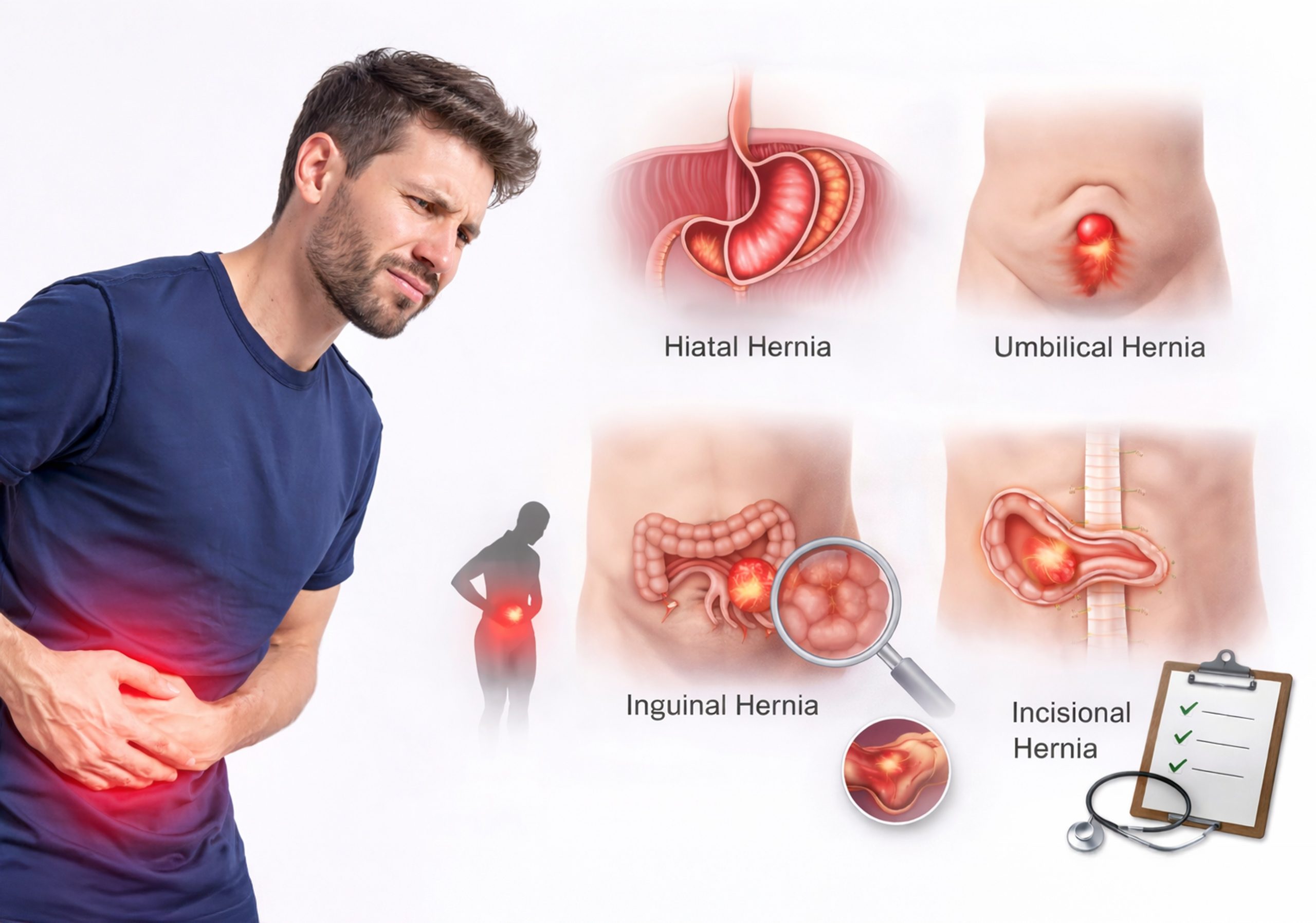
A hernia occurs when an organ or tissue pushes through a weak spot in the surrounding muscle or connective tissue. While hernias are common—affecting millions of people worldwide—many individuals delay seeking treatment due to lack of awareness about symptoms or fear of surgery. At LLH Hospital Abu Dhabi, our experienced general and laparoscopic surgeons specialize in diagnosing and treating all types of hernias using advanced, minimally invasive techniques.
Understanding the different types of hernias, recognizing their symptoms, and knowing when to seek medical attention can prevent serious complications and ensure optimal outcomes. This comprehensive guide will help you identify hernia symptoms and understand your treatment options at LLH Hospital.
What is a Hernia?
A hernia develops when internal organs or tissues protrude through a weakened area in the muscle wall that normally contains them. Think of it like a tire with a weak spot—when pressure builds up, the inner tube pushes through the weakened area, creating a bulge.
Hernias can occur in various locations throughout the abdomen and groin area. While some hernias cause minimal discomfort, others can lead to severe complications if left untreated.
Why Do Hernias Occur?
Hernias develop due to a combination of muscle weakness and strain. Common contributing factors include:
- Congenital weakness present from birth
- Age-related muscle deterioration
- Injury or surgical incisions
- Chronic coughing or sneezing
- Pregnancy and childbirth
- Obesity and excess abdominal pressure
- Heavy lifting without proper technique
- Chronic constipation and straining
- Fluid accumulation in the abdomen
Common Types of Hernias
Understanding the different types of hernias is crucial for proper identification and treatment. Here are the most common types our surgeons treat at LLH Hospital:
1. Inguinal Hernia (Groin Hernia)
What It Is: Inguinal hernias are the most common type, accounting for approximately 75% of all hernias. They occur when tissue pushes through a weak spot in the inguinal canal, located in the groin area.
Who Gets It:
- Predominantly affects men (25 times more common than in women)
- Can occur at any age, including infants
- More common in older adults
Symptoms:
- Visible bulge in the groin area, especially when standing or coughing
- Burning, aching, or heavy sensation in the groin
- Pain that worsens with physical activity, lifting, or prolonged standing
- Swelling around the testicles in men
- Bulge that may disappear when lying down
- Discomfort that intensifies throughout the day
Types:
- Direct inguinal hernia: Usually develops in older adults due to weakened abdominal muscles
- Indirect inguinal hernia: More common in younger people, often present from birth
2. Femoral Hernia
What It Is: Femoral hernias occur when tissue pushes through the femoral canal, just below the inguinal ligament in the upper thigh.
Who Gets It:
- More common in women, especially pregnant or obese women
- Often affects older adults
- Less common than inguinal hernias but has higher complication rates
Symptoms:
- Small bulge near the groin or top of the thigh
- Hip or groin pain that worsens with standing or lifting
- Abdominal discomfort
- Nausea and vomiting if bowel becomes trapped
- Often less noticeable than inguinal hernias
Why It’s Serious: Femoral hernias have a higher risk of strangulation (when blood supply is cut off) and require prompt surgical attention.
3. Umbilical Hernia (Belly Button Hernia)
What It Is: Umbilical hernias develop when tissue protrudes through the abdominal wall near the belly button.
Who Gets It:
- Common in infants (especially premature babies)
- Affects women more than men in adulthood
- Risk increases with pregnancy, obesity, and multiple pregnancies
Symptoms:
- Visible bulge or swelling at the belly button
- Bulge becomes more prominent when crying, coughing, or straining (in infants)
- Mild discomfort or pain in adults
- Feeling of pressure at the belly button
- Nausea if intestine becomes trapped
Special Note: In infants, small umbilical hernias often close naturally by age 1-2 years. However, adult umbilical hernias require surgical repair.
4. Incisional Hernia
What It Is: Incisional hernias develop at the site of a previous surgical incision where the abdominal wall has weakened.
Who Gets It:
- Anyone who has had abdominal surgery
- Higher risk with obesity, infection, or poor wound healing
- Can develop months or years after surgery
Symptoms:
- Bulge near or at the site of a previous surgical scar
- Pain or discomfort at the hernia site
- Bulge that increases in size over time
- Redness or discoloration if complications develop
- Aching sensation that worsens with activity
Risk Factors:
- Infection at the surgical site
- Obesity
- Smoking
- Chronic cough
- Heavy lifting too soon after surgery
- Poor nutrition affecting wound healing
5. Hiatal Hernia
What It Is: A hiatal hernia occurs when part of the stomach pushes upward through the diaphragm into the chest cavity.
Who Gets It:
- More common in people over 50
- Affects women more than men
- Associated with obesity and pregnancy
Symptoms:
- Heartburn and acid reflux
- Chest pain or discomfort
- Difficulty swallowing
- Belching and bloating
- Shortness of breath
- Regurgitation of food or liquids
- Many people have no symptoms
Types:
- Sliding hiatal hernia: Most common; the stomach and esophagus slide up into the chest
- Paraesophageal hiatal hernia: Less common but more serious; part of the stomach pushes through the diaphragm
6. Epigastric Hernia
What It Is: Epigastric hernias occur in the upper abdomen, between the belly button and the breastbone.
Who Gets It:
- More common in men
- Can occur at any age
- Often multiple hernias develop
Symptoms:
- Small, tender lump in the upper abdomen
- Pain in the upper abdomen, especially when straining
- May be pain-free and discovered incidentally
- Discomfort that comes and goes
7. Spigelian Hernia
What It Is: A rare hernia that develops along the edge of the abdominal muscle, typically below the belly button.
Who Gets It:
- Uncommon (accounts for less than 2% of hernias)
- Usually occurs in adults aged 50-70
Symptoms:
- Often difficult to detect visually
- Vague abdominal pain
- Change in bowel habits
- Intermittent bulge that may not be visible
- Higher risk of strangulation due to delayed diagnosis
8. Obturator Hernia
What It Is: An extremely rare hernia through the obturator canal in the pelvis.
Who Gets It:
- Predominantly affects elderly, thin women
- Very rare (less than 1% of hernias)
Symptoms:
- Inner thigh and groin pain
- Bowel obstruction symptoms
- Nausea and vomiting
- Often difficult to diagnose
- Pain that radiates down the inner thigh
Recognizing Hernia Symptoms: When to Seek Medical Care
While hernia symptoms vary by type and location, there are common warning signs that warrant medical attention.
General Hernia Symptoms:
- Visible bulge or lump: Most noticeable when standing, coughing, or straining
- Discomfort or pain: Ranging from mild aching to severe pain
- Feeling of heaviness: Particularly in the groin or abdomen
- Burning or gurgling sensation: At the bulge site
- Weakness or pressure: In the affected area
- Bulge that disappears when lying down: Common in reducible hernias
Emergency Symptoms Requiring Immediate Care:
Seek emergency medical attention if you experience:
- Severe, sudden pain at the hernia site
- Inability to push the bulge back in (incarcerated hernia)
- Nausea and vomiting with abdominal pain
- Bulge becomes firm, tender, or discolored
- Inability to pass gas or have bowel movements
- Fever along with hernia symptoms
- Rapid heart rate or feeling faint
- Abdominal distension and severe pain
These symptoms may indicate a strangulated hernia—a life-threatening emergency where blood supply to the trapped tissue is cut off. This requires immediate surgical intervention.
Diagnosing Hernias at LLH Hospital Abu Dhabi
At LLH Hospital, our General and Laparoscopic Surgery Department uses a comprehensive approach to diagnose hernias accurately and determine the most appropriate treatment plan.
Clinical Examination
Initial Assessment: Our experienced surgeons begin with a thorough physical examination that includes:
- Discussion of your medical history and symptoms
- Visual inspection of the affected area
- Palpation (gentle touch examination) to feel for bulges
- Asking you to cough or strain to make the hernia more prominent
- Assessment while standing and lying down
- Evaluation of hernia reducibility
Advanced Diagnostic Imaging
When needed, we utilize state-of-the-art imaging technology:
Ultrasound:
- Non-invasive and radiation-free
- Excellent for groin hernias
- Can assess hernia contents and size
- Real-time imaging during movement
CT Scan (Computed Tomography):
- Detailed cross-sectional images
- Ideal for complex or internal hernias
- Helps identify complications
- Useful for surgical planning
MRI (Magnetic Resonance Imaging):
- Superior soft tissue visualization
- Useful for difficult-to-diagnose hernias
- No radiation exposure
- Particularly helpful for abdominal wall hernias
X-rays:
- May be used to check for bowel obstruction
- Helpful in emergency situations
Specialized Assessment
For complex cases, our multidisciplinary approach may include:
- Consultation with gastroenterologists (for hiatal hernias)
- Pain specialists (for chronic pain assessment)
- Nutritionists (for obesity-related hernias)
- Physical therapists (for post-surgical recovery planning)
Treatment Options: Modern Hernia Repair at LLH Hospital
At LLH Hospital, we offer comprehensive hernia treatment ranging from watchful waiting to advanced laparoscopic surgery. Our approach is tailored to each patient’s specific condition, overall health, and lifestyle needs.
Watchful Waiting
When It May Be Appropriate:
- Very small, asymptomatic hernias
- Patients with significant medical conditions making surgery high-risk
- Minimal symptoms not affecting quality of life
Important Note: Hernias do not heal on their own and will not disappear without treatment. Watchful waiting requires regular monitoring and most hernias will eventually require surgical repair.
Surgical Repair: The Definitive Solution
Surgery is the only permanent cure for hernias. At LLH Hospital, we specialize in both traditional open repair and advanced laparoscopic techniques.
Laparoscopic Hernia Repair: Minimally Invasive Excellence
LLH Hospital is a leader in minimally invasive laparoscopic hernia surgery, offering patients significant advantages over traditional open surgery.
What is Laparoscopic Hernia Repair?
Laparoscopic surgery uses small incisions (typically 5-10mm) through which a camera and specialized instruments are inserted. The surgeon views the procedure on high-definition monitors and repairs the hernia using surgical mesh to reinforce the weakened area.
Advantages of Laparoscopic Surgery:
Patient Benefits:
- Smaller incisions: Multiple tiny incisions instead of one large cut
- Less post-operative pain: Significantly reduced discomfort
- Faster recovery: Return to normal activities in 1-2 weeks
- Shorter hospital stay: Often same-day or next-day discharge
- Reduced infection risk: Smaller wounds mean lower infection rates
- Better cosmetic results: Minimal scarring
- Lower recurrence rates: Mesh reinforcement provides strong repair
- Quick return to work: Most patients resume work within 1-2 weeks
Surgical Advantages:
- Better visualization of the hernia and surrounding anatomy
- Ability to check and repair hernias on both sides simultaneously
- Reduced trauma to surrounding tissues
- More precise mesh placement
Types of Laparoscopic Hernia Repairs at LLH Hospital:
TAPP (Trans-Abdominal Pre-Peritoneal) Repair:
- Approach through the abdominal cavity
- Excellent for bilateral hernias
- Allows complete visualization
TEP (Totally Extra-Peritoneal) Repair:
- Does not enter the abdominal cavity
- Lower risk of bowel injury
- Ideal for recurrent hernias
Laparoscopic Ventral/Incisional Hernia Repair:
- Minimally invasive approach for abdominal wall hernias
- Enhanced mesh fixation techniques
- Faster recovery than open repair
Open Hernia Repair
For certain patients and hernia types, traditional open surgery remains the best option.
When Open Surgery Is Recommended:
- Very large hernias
- Recurrent hernias with previous mesh
- Emergency situations with bowel strangulation
- Patient preference or medical conditions precluding laparoscopy
- Limited access to the hernia site
Open Repair Techniques:
Lichtenstein Repair:
- Gold standard for inguinal hernia repair
- Uses mesh to reinforce the abdominal wall
- Performed under local or general anesthesia
- Time-tested with excellent long-term results
Primary Tissue Repair:
- Suturing muscle layers without mesh
- Used for small hernias in specific situations
- Higher recurrence rates than mesh repair
Component Separation:
- Advanced technique for large, complex hernias
- Releases abdominal wall muscles to achieve closure
- May be combined with mesh reinforcement
Mesh vs. Non-Mesh Repair
Mesh Repair:
Advantages:
- Lower recurrence rates (1-3% vs. 10-20% without mesh)
- Stronger, more durable repair
- Less tension on tissues
- Faster recovery
Types of Mesh:
- Synthetic (polypropylene, polyester)
- Biologic (derived from human or animal tissue)
- Composite (combination materials)
Our surgeons select the most appropriate mesh based on hernia type, size, location, and individual patient factors.
Non-Mesh Repair:
When Considered:
- Contaminated or infected surgical fields
- Patient preference after thorough counseling
- Certain pediatric hernias
- Selected small hernias in young patients
Meet Our Expert Hernia Surgery Team
The General and Laparoscopic Surgery Department at LLH Hospital Abu Dhabi is staffed by highly skilled surgeons with extensive training and experience in hernia repair.
Our Surgical Expertise:
Advanced Training:
- Board-certified general surgeons
- Specialized fellowship training in laparoscopic surgery
- Years of experience performing hundreds of hernia repairs annually
- Continuous education in the latest surgical techniques
Comprehensive Capabilities:
- All types of hernia repairs (inguinal, femoral, umbilical, incisional, hiatal)
- Both laparoscopic and open surgical approaches
- Emergency hernia surgery available 24/7
- Complex and recurrent hernia repairs
- Robotic-assisted surgery for select cases
Patient-Centered Philosophy: Our surgeons understand that each patient is unique. We take time to:
- Listen to your concerns and answer all questions
- Explain your diagnosis in clear, understandable terms
- Discuss all treatment options, including risks and benefits
- Involve you in decision-making about your care
- Provide compassionate support throughout your treatment journey
Why Choose LLH Hospital for Hernia Surgery?
State-of-the-Art Facilities:
- Modern operating rooms equipped with advanced laparoscopic technology
- High-definition imaging systems for precision surgery
- Dedicated recovery areas with experienced nursing staff
Multidisciplinary Care:
- Collaboration with anesthesiologists, pain specialists, and nutritionists
- Comprehensive pre-operative assessment
- Personalized post-operative care plans
Proven Outcomes:
- High success rates with low complication rates
- Minimal recurrence rates
- Excellent patient satisfaction scores
Convenient Location:
- Easily accessible in Abu Dhabi
- Ample parking and comfortable waiting areas
- Multilingual staff to serve diverse patient populations
Schedule Your Hernia Consultation Today
Don’t let a hernia hold you back from living your best life. The expert team at LLH Hospital’s General and Laparoscopic Surgery Department is ready to provide the comprehensive care you deserve.
Take the First Step:
Whether you’ve noticed a bulge, experienced discomfort, or want a second opinion, we’re here to help.
Benefits of Early Consultation:
- Prevent complications
- Explore all treatment options
- Peace of mind with accurate diagnosis
- Plan surgery at a convenient time
- Faster, easier recovery with early treatment
What to Expect at Your First Visit:
- Comprehensive evaluation by an experienced surgeon
- Discussion of your symptoms and medical history
- Physical examination
- Diagnostic imaging if needed
- Clear explanation of findings and recommendations
- Opportunity to ask questions
- Personalized treatment plan
Contact LLH Hospital Abu Dhabi
Department of General and Laparoscopic Surgery
Call Now: 800 55
Visit Our Website: www.llhhospital.com
Easy Appointment Scheduling:
- Call our dedicated appointment line
- Walk-in consultations available
- Emergency care available around the clock
Frequently Asked Questions About Hernias
Q: Can a hernia go away on its own without surgery?
A: No, hernias do not heal naturally and will not disappear without surgical repair. They typically grow larger over time and increase the risk of complications.
Q: Is hernia surgery painful?
A: With modern surgical techniques, especially laparoscopic surgery, post-operative pain is minimal and well-managed with medications. Most patients describe discomfort rather than severe pain.
Q: How long do I need to stay in the hospital?
A: For laparoscopic hernia repair, most patients go home the same day or the next morning. Open surgery may require 1-3 days depending on the complexity.
Q: When can I return to work after hernia surgery?
A: This depends on your job and the type of surgery. For desk jobs after laparoscopic surgery, most patients return within 1-2 weeks. Physically demanding jobs may require 4-6 weeks.
Q: What is the success rate of hernia surgery?
A: Modern hernia repair with mesh has a success rate of over 95%, with recurrence rates of only 1-3% when performed by experienced surgeons.
Q: Can hernias recur after surgery?
A: While rare with modern techniques (1-3% recurrence rate), hernias can return, especially if risk factors like obesity, chronic cough, or heavy lifting aren’t addressed.
Q: Is mesh safe? Can I be allergic to surgical mesh?
A: Surgical mesh used in hernia repair has been proven safe and effective over decades. True allergic reactions are extremely rare. Your surgeon will discuss mesh options and address any concerns.
Q: Can I exercise after hernia surgery?
A: Yes, but gradually. Light walking is encouraged immediately after surgery. More strenuous exercise should wait 4-6 weeks until tissues fully heal.
Q: What if my hernia is very small and doesn’t bother me much?
A: Even small hernias should be evaluated by a surgeon. While some small hernias can be monitored, they tend to grow over time and increase complication risks.
Q: Are there any dietary restrictions after hernia surgery?
A: Initially, you’ll start with light, easily digestible foods. Within a few days, most patients can resume a normal diet. High-fiber foods are recommended to prevent constipation.
Q: Can I drive after hernia surgery?
A: You can resume driving when you’re no longer taking narcotic pain medications and can comfortably perform emergency maneuvers. This is typically 3-7 days after laparoscopic surgery.
Q: Will I have visible scars?
A: Laparoscopic surgery results in minimal scarring—typically three to four small incisions of 5-10mm. Open surgery scars vary by location but are placed to minimize visibility.
Don’t Wait—Take Control of Your Health Today
A hernia won’t heal on its own, but with expert care from LLH Hospital’s General and Laparoscopic Surgery Department, you can get back to living life without limitations. Our experienced team uses the latest minimally invasive techniques to ensure the best possible outcomes with the fastest recovery.